
Most French employees spend the majority of their day indoors. Among them, a significant proportion work in windowless offices or those located far from any glazing. The lack of natural light in the office is not just a matter of discomfort: it affects sleep, mood, and the physiology of workers, with mechanisms that research is beginning to document more thoroughly.
Circadian rhythm and sleep: how the absence of windows in the office changes things
The link between natural light during the day and the quality of nighttime sleep is the most well-supported by research. A pilot study published in 2014 compared employees working in offices with or without windows, measuring their light exposure and sleep through actigraphy. The result: employees with access to daylight slept longer and had significantly higher light exposure during the day.
The sample size of this study remains modest, making it a suggestive result rather than definitive proof. The limitation is methodological: the researchers could not control for all individual variables (bedtime habits, evening screen use).
What emerges from reviews of studies on light and sleep is that the timing of light exposure matters as much as its quantity. Morning light exposure is generally associated with an earlier sleep rhythm, while strong light in the evening can delay it.
A windowless office deprives the employee of this morning signal, but a break outside early in the day could partially compensate for this deficit. As detailed by the B4Business site and its articles, the health effects vary depending on the degree of isolation from daylight.

Mental health and employee fatigue in spaces without natural light
Disrupted sleep is just the first link in the chain. The resulting chronic fatigue feeds into a cycle where mood, concentration, and motivation deteriorate. Studies on light and seasonal affective disorders show that prolonged deprivation of natural light is associated with mood drops, even outside the winter period.
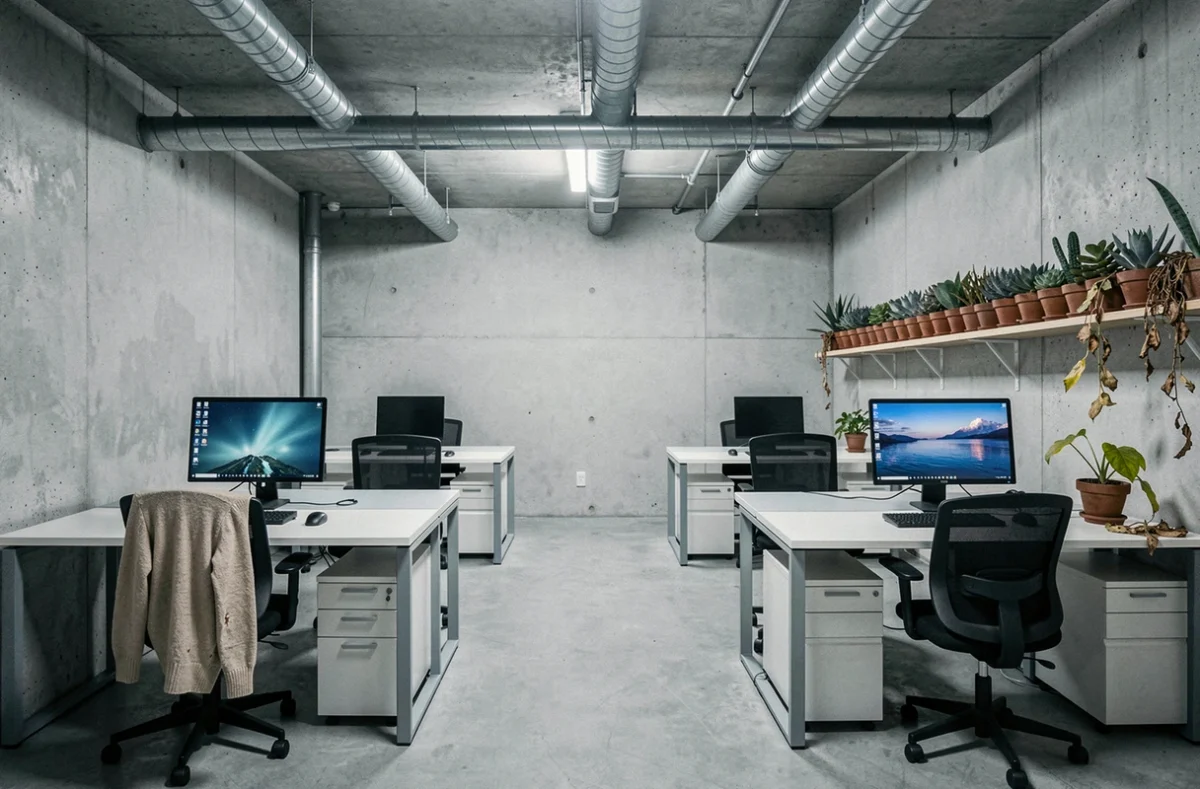
In a windowless office, standard artificial lighting does not replicate the light spectrum of the sun. The color temperature and intensity remain constant throughout the day, whereas natural light varies from morning to evening. This light monotony does not provide the temporal cues the brain needs to regulate melatonin and cortisol production.
The consequences reported by affected employees are fairly consistent:
- A feeling of fatigue by mid-morning, even after a normal-length night
- An increased difficulty in maintaining attention on long tasks, with a more frequent need for breaks
- A sense of confinement that weighs on morale, especially when the workstation offers no view of the outside
These effects are not identical from one person to another. Sensitivity to light varies, and an employee who takes their breaks outside will not have the same experience as another who stays indoors all day.
Windows in the office and legal framework: employer obligations in France
The Labor Code establishes a principle: workspaces must have sufficient natural light as much as possible. The wording “as much as possible” allows for some interpretation, but obligations become clearer when the office is completely windowless.
The employer must then implement compensatory measures. Regulations specifically require arranged breaks and appropriate artificial lighting. There is no specific legal bonus to compensate for the lack of natural light. Some collective agreements, such as that of the pharmacy sector, provide for a “basement bonus,” but these arrangements fall under collective negotiation, not a general obligation.
No automatic penalty applies to the employer in the absence of windows, provided that artificial lighting standards are met and the planned compensations are effective. The legal ambiguity mainly concerns the definition of “sufficient” in terms of natural light.
Artificial lighting in the office: compensating does not mean replacing
The idea that good artificial lighting is sufficient to compensate for the absence of a window deserves nuance. A window does not only provide light: it offers a view, a perception of the weather, a visual time marker. No light fixture replicates these functions.
From a strictly photometric standpoint, solutions exist. Dynamic spectrum lighting, which changes its color temperature throughout the day, attempts to mimic the natural cycle. Their effectiveness on the circadian rhythm is under research, but data is lacking to assert that they equate to actual sun exposure.
Another blind spot concerns the orientation and distance from the glazing. An office technically “with windows” but where the workstation is several meters from the glazing, behind partitions or facing closed blinds, does not necessarily offer better exposure than a well-lit windowless space. The presence of a window does not guarantee good light quality at the workstation on its own.
- The orientation of the building (north, south, east, or west) radically alters the amount of incoming light
- Anti-glare blinds, often lowered by reflex, reduce the light input to a fraction of what it could be
- The depth of the floor plate in open spaces means that central workstations receive very little natural light
The most realistic approach for an employee working far from a window remains to combine quality artificial lighting with regular breaks outside, especially in the morning. Ten to fifteen minutes of morning outdoor light can reset the circadian rhythm more effectively than a high-end light fixture left on for eight hours. The issue of the windowless office is not solely technical: it is also a matter of work time organization and corporate culture.