
A technical audit, a link-building campaign, an editorial overhaul and local optimisation require different skills and budgets. Choosing the right SEO services starts with understanding exactly what each one covers, then comparing that with your website’s maturity and business goals.
Google’s spam policies and how they affect your choice of SEO service
You can no longer choose an SEO provider without assessing whether they comply with Google’s spam policies. Since Google strengthened its policy against scaled content abuse, producing content at scale—whether automated or semi-automated—can expose a website to partial or complete deindexing.
An SEO writing service that offers hundreds of pages a month without human editorial oversight poses a direct risk. Before signing, ask how the provider checks the originality of every deliverable and protects against algorithmic penalties.
The same applies to link building. Google also targets site reputation abuse—hosting third-party content on a high-authority domain solely to manipulate rankings. Sponsored link campaigns disguised as guest posts on third-party sites are under scrutiny. A provider offering links on domains with no topical relevance to your business is doing you no favours.
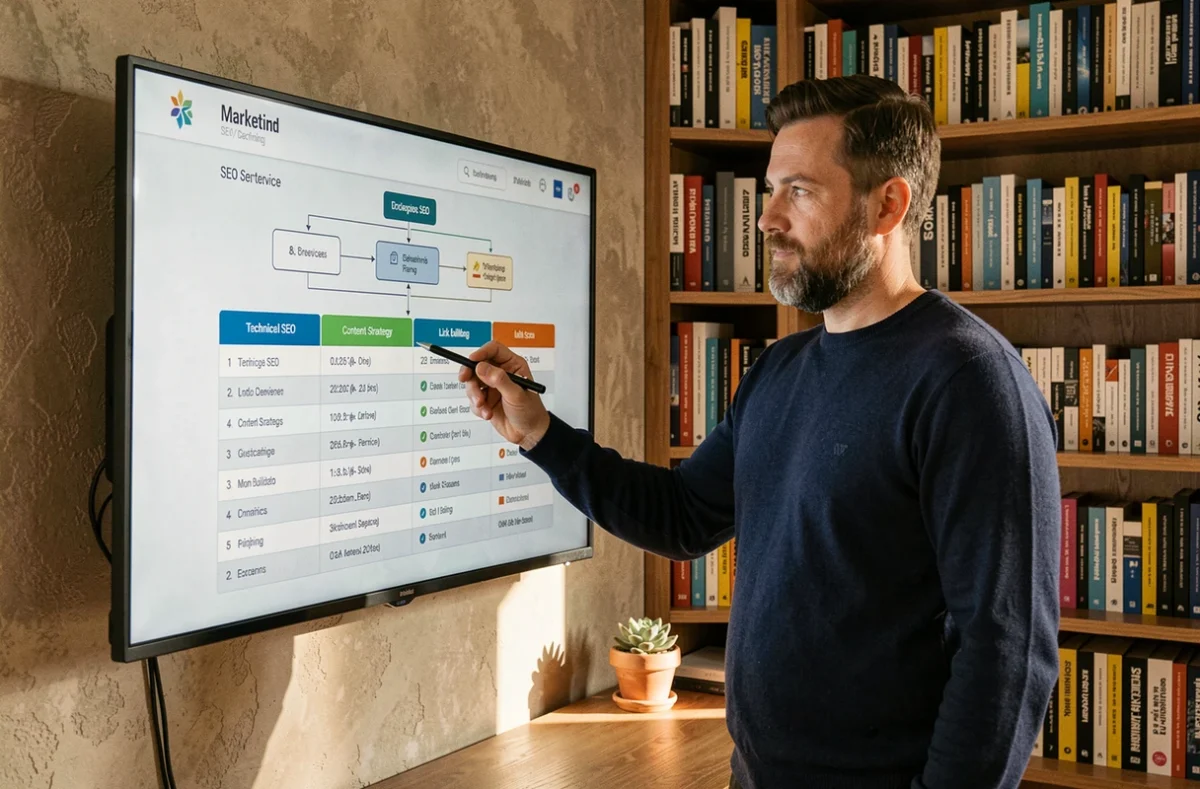
To better map out the different SEO services and understand what each one covers, start with these compliance requirements to rule out risky services from the outset.
Technical SEO audits and on-page optimisation: two distinct services
Technical audits and on-page optimisation are often sold as a package. However, they are two different deliverables, each requiring specific skills and timelines.
What a technical audit covers
A technical audit analyses a website’s infrastructure: server response times, crawl budget, index coverage, structured data, redirect management, and robots.txt and XML sitemap configuration. The deliverable is a report listing issues ranked by their impact on indexation.
A thorough audit uses at least Google Search Console and a dedicated crawler (Screaming Frog, Sitebulb or equivalent). SaaS tools such as Semrush or Ahrefs complement the analysis but cannot replace human interpretation of crawl data.
What on-page optimisation covers
On-page optimisation follows the audit. It focuses on visible content: title tags, meta descriptions, heading structure, internal linking, lexical density and search intent. A consultant who delivers an audit without an on-page action plan leaves you with a diagnosis but no treatment.
Ask for a separate deliverable for each service, with distinct tracking metrics. An audit is measured by the number of issues fixed and the indexation rate. On-page optimisation is measured by ranking improvements for target queries.
Link building, content and local SEO: prioritise according to your website’s maturity
Not every website needs every service at the same time. A common mistake is launching a link-building campaign on a website with weak technical foundations.
- New website or one undergoing a redesign: prioritise a technical audit and information architecture. Link building at this stage wastes budget because target pages have not yet been properly indexed.
- Indexed but not very visible: on-page optimisation and content strategy take priority. Keyword research should target transactional or informational queries aligned with your offering.
- Website with existing organic traffic: link building and local SEO become relevant. Inbound links strengthen domain authority, while optimising your Google Business Profile captures local searches for businesses with a geographic presence.
We find that providers offering an “all-inclusive” package without an initial assessment often apply the same formula to every client. A good provider will start by ruling out services that do not match your stage of development.
Measure SEO results beyond organic traffic
AI Overviews and AI-generated summaries in Google search results are changing how users interact with pages. A Pew Research Center analysis published in July 2025 reports that users were less likely to click on a traditional result when an AI summary appeared, and clicks on links included in that summary were rare.
This shift directly affects your choice of SEO services: a provider that measures only organic sessions gives you an incomplete picture. Ask how they track impressions in Google Search Console, website conversions and brand visibility in search queries.
On May 21, 2025, Google stated that its usual SEO recommendations remain relevant for AI Overviews and AI Mode. No special markup or dedicated file is required. Be wary of offers charging for technical optimisation specifically for “AI SEO”: as of today, this is not based on any specification published by Google.

Choosing an SEO service comes down to getting the sequence right: fix the infrastructure first, optimise the content next, and build authority last. Each service should have its own performance metrics, agreed upon before work begins. A provider who cannot explain what they measure or how they distinguish their results from statistical noise does not deserve your budget.